

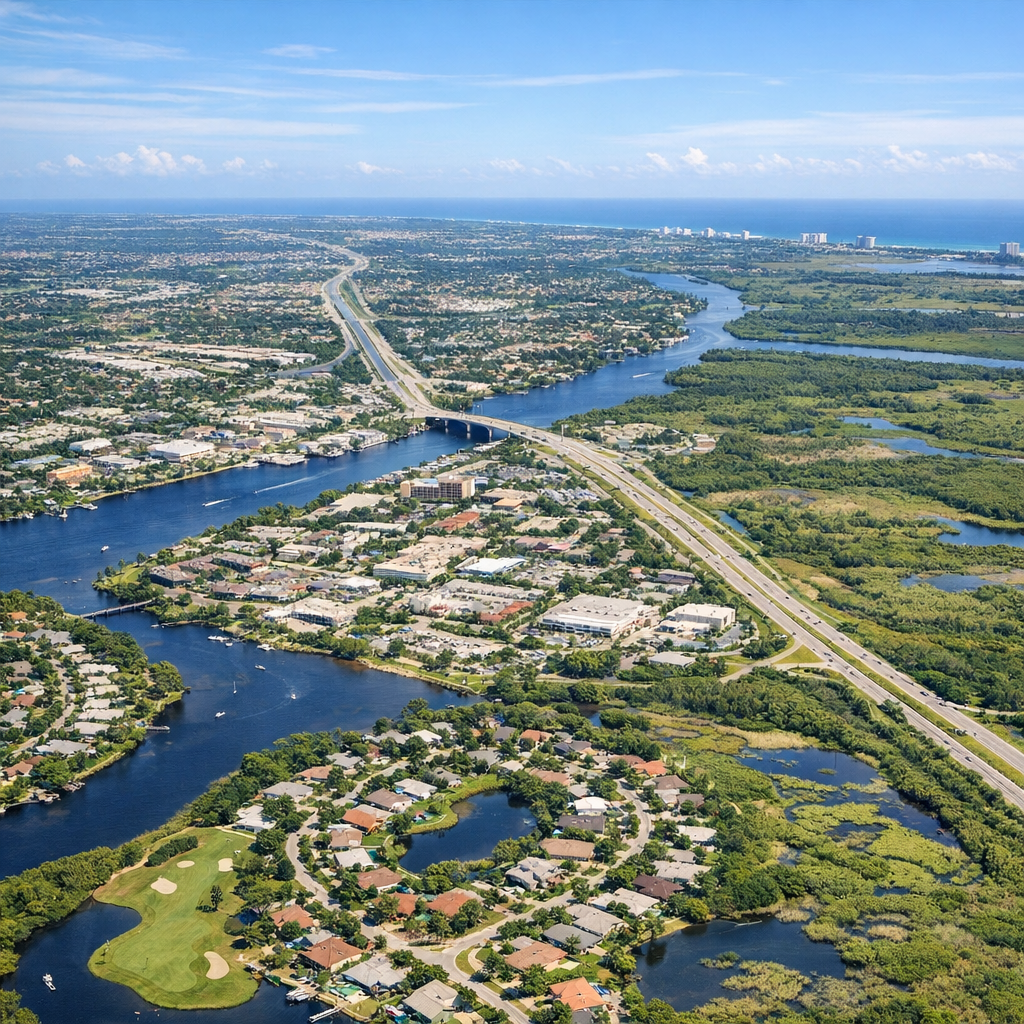
Port St. Lucie, Florida, has long been emblematic of broader national patterns, reflecting shifts in demographics, economy, and environmental concerns.
Population Growth and Economic Shifts
Once among the fastest-growing metropolitan areas in the nation, Port St. Lucie experienced a slowdown in population growth during 2024-2025, dropping to the 14th-fastest-growing metro area. This mirrors a national trend of decelerating population increases, influenced by factors such as reduced international migration.
Economically, the city has faced significant changes. Amazon’s fulfillment center in Port St. Lucie announced a two-year closure starting September 17, 2026, for a $200 million upgrade. This temporary shutdown affects 850 employees, highlighting the broader economic shifts and challenges in the region.
Environmental Challenges
Environmental issues have also come to the forefront. In March 2026, the U.S. Army Corps of Engineers initiated a revised schedule to address beach erosion in Fort Pierce, a neighboring area. The project involves placing approximately 400,000 cubic yards of sand along a mile of shoreline south of the Fort Pierce Inlet, reflecting national concerns over coastal erosion and climate change impacts.
Community Resilience
Despite these challenges, Port St. Lucie has demonstrated resilience. In June 2025, the city was honored as an All-America City by the National Civic League, recognizing its community-driven efforts to enhance environmental sustainability and civic infrastructure. This accolade underscores the city’s commitment to addressing both local and national issues through proactive community engagement.
Port St. Lucie’s experiences serve as a microcosm of broader national trends, illustrating how local communities navigate and adapt to evolving demographic, economic, and environmental landscapes.